How to Turn Chatbot Conversations Into CRM Leads (Without Zapier)
 Zaid 9 min read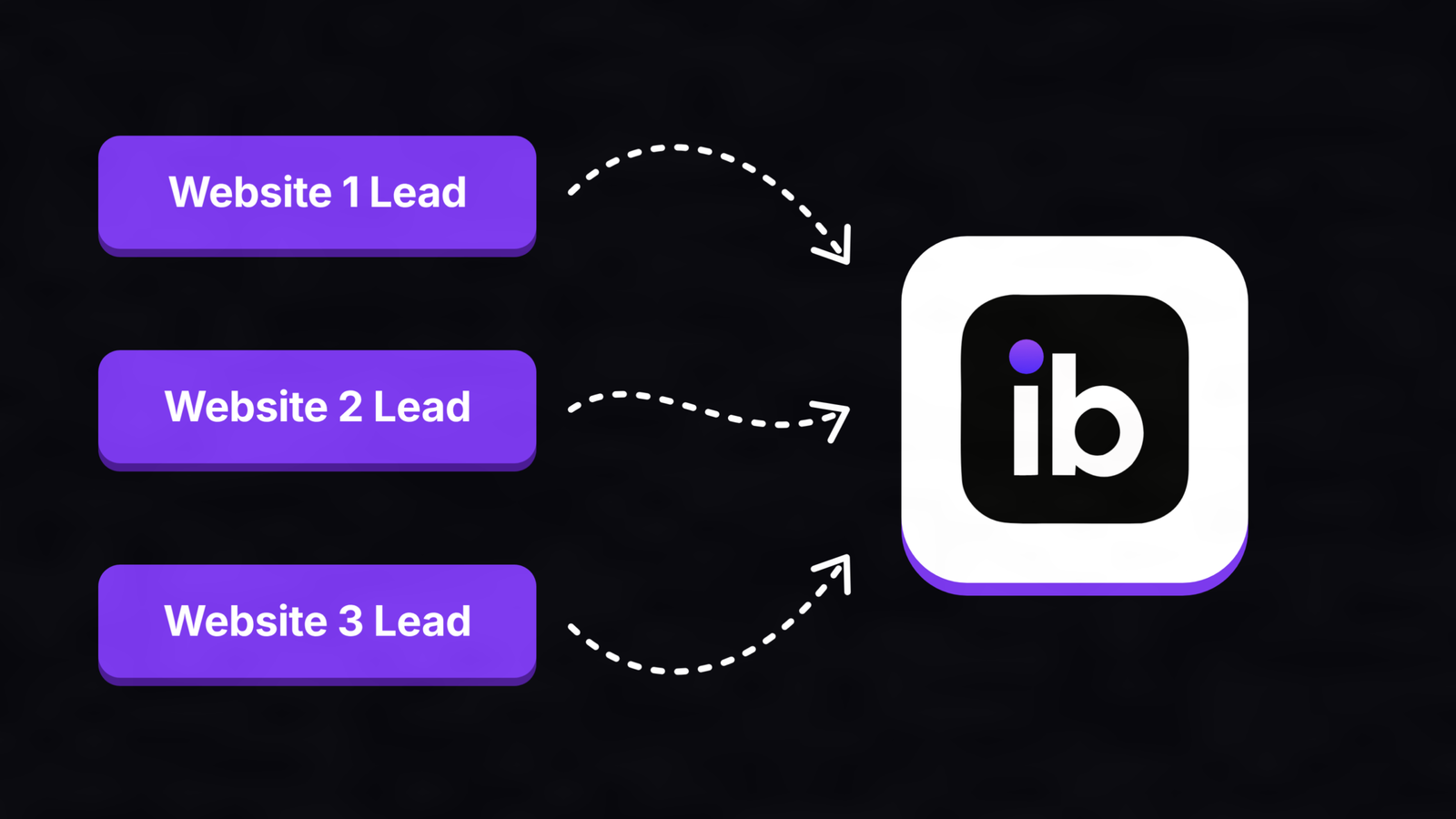
To turn chatbot conversations into CRM leads without Zapier, have the chatbot send the lead directly to your CRM once a visitor shares their contact details. Use a native CRM sync, a webhook to your CRM’s own endpoint, the CRM’s API, or a chat tool built into the CRM. Send only qualified chats, match on email, and include a short summary.
Key takeaways
- A chatbot conversation is not a lead until it has contact details and a reason to follow up. Decide that rule first.
- Pick the shortest path: native sync, then webhook, then direct API. Middleware is the last resort, not the default.
- Send a short summary and a link to the transcript, not the whole chat.
- Set the lead source to “AI chatbot” and match on email so you can measure results and avoid duplicates.
- Keep an alert running, so you notice when the sync stops.
Why do chatbot conversations get lost?
Because the conversation lives in the chatbot’s dashboard and the lead needs to live in your CRM. If nobody copies one into the other, the visitor who asked about pricing at 9 pm is still sitting in a chat log when your team opens the CRM the next morning.
Two things make it worse. A chat has no owner or follow-up task, and it is easy to confuse “lots of conversations” with “lots of leads”. Most chats are people reading an answer and leaving. Only a few are worth a CRM record, and the gap between those two groups is where the work is.
What counts as a lead worth sending to your CRM?
A chat counts as a lead when the visitor gave a valid email (or phone) and met at least one qualifying condition. Anything less belongs in the chatbot’s conversation log, not your CRM.
| Rule | Example | Result |
|---|---|---|
| Valid email given | visitor types an email and it passes a basic check | Eligible |
| Plus a qualifying condition | asked about pricing, asked for a quote, asked to book, or named a budget or timeline | Send to CRM |
| Email but no intent | asked a support question, then left an email for a newsletter | Send to a different list, not the sales pipeline |
| No email | read three answers and closed the tab | Keep in the chat log only |
Zapier’s own public chatbot templates follow the same idea: they route only qualifying conversations and mark the record as chatbot-sourced. You can do the same without Zapier by putting the rule in the chatbot or in the first step of your sync.
What can you use instead of Zapier?
There are four direct routes: a native CRM sync, a webhook to your CRM’s own endpoint, a direct call to the CRM’s API, or a chat tool built into the CRM itself. Choose the first one your tools support, because each extra hop is another place to fail without telling you.
| Method | How it works | Effort | Best when | Watch out for |
|---|---|---|---|---|
| Native sync | The chatbot platform has a built-in connector to your CRM | Minutes | Your chatbot and CRM are both supported | Fixed field options, limited rules |
| Webhook to the CRM | The chatbot posts the lead to a URL your CRM accepts | About an hour | The chatbot can send a webhook and your CRM has an intake or API endpoint | Authentication and payload shape differ by CRM |
| Direct API | Your own server calls the CRM’s API after a qualifying chat | A day or more | You have a developer and need full control | You must write and maintain the code |
| CRM-built chat | The CRM provides its own chat widget | Minutes | You are happy to use the CRM’s chatbot | Less control over the AI and training |
Quick decision guide
- Does your chatbot list your CRM as a built-in integration? Use it.
- If not, can it send a webhook? Point it at your CRM’s intake or API endpoint (check your CRM’s docs), or at a small endpoint you control.
- If you have a developer and need custom rules, use the direct API.
- If you have no chatbot yet and your CRM includes one, use it.
When middleware is still fine: if none of the above exist and nobody can build a small endpoint, a connector tool such as Zapier or Make is a reasonable fallback. It is just one more system, bill and failure point.
What should a chatbot send to your CRM?
Send the fields a rep needs to follow up, plus the ones you need to measure results. Decide this before you build, because fixing the mapping later means editing old records by hand.
| Chat data | CRM field | Notes |
|---|---|---|
| Name | First and last name | Ask for it early, in plain language |
| Primary email | Also your match key for duplicates | |
| Phone | Phone | Ask only when the intent justifies it |
| Company | Company | Optional on early-stage chats |
| What they wanted | Note or description | One or two sentences |
| Qualifying answers | Custom fields | Budget range, timeline, product interest |
| Conversation summary | Note or activity | Short, AI-written |
| Transcript link | Custom link field | Full chat stays in the chatbot dashboard |
| Page URL, UTM values | One field each | Lets you report on which page or campaign produced the chat |
| Source | Lead source = “AI chatbot” (fixed value) | The field teams forget |
| Consent | Consent field with date | Confirm consent requirements with your legal adviser |
| Conversation ID | Custom field | Used to spot retries and duplicates |
| Owner | Lead owner | Set by a routing rule, never blank |
Summary or full transcript? Send a summary and a link. Reps read two sentences, not forty messages, and full transcripts can hold personal details that do not belong in a CRM. If you do store full transcripts, set a retention rule.
How do you get the email inside a chat?
Ask for it at the moment the visitor wants something you can only deliver by email or a call, not at the start. A chatbot that asks for an email before answering gets ignored.
- Answer first. Give a useful answer to the question.
- Offer a next step. “Want a quote sent over?” or “Want someone to call you?”
- Ask for the minimum. Name and email, plus phone only if they asked for a call.
- Say what happens next and how their details will be used (this doubles as your consent notice).
- If they refuse, keep chatting. Do not create a lead.
What does a chat-to-CRM payload look like?
It is a single message with the lead’s details, a short summary and a few tracking fields. Here is an illustrative example (field names differ by tool):
{
“conversation_id”: “conv_000451”,
“ended_at”: “2026-10-10T21:47:12Z”,
“name”: “Priya Nair”,
“email”: “priya@example.com”,
“phone”: “+15551234567”,
“company”: “Nair Studio”,
“intent”: “pricing”,
“qualification”: {
“budget_range”: “1000-5000”,
“timeline”: “this month”
},
“summary”: “Asked about pricing for a 5-page site and wants a quote this month.”,
“transcript_url”: “https://example.com/conversations/conv_000451”,
“source”: “AI chatbot”,
“page_url”: “https://example.com/pricing”,
“utm_source”: “google”,
“utm_medium”: “cpc”,
“consent”: true
}
The conversation_id is the quiet hero. It lets the receiver recognise a retry as the same chat instead of creating a second lead.
How do you set it up, step by step?
- Define a lead. Write the rule: valid email plus one qualifying condition.
- Choose a method using the decision guide above.
- Define the field mapping from the table above.
- Set up the chatbot’s capture step to ask for details at the right moment, with a consent line.
- Connect the chatbot to the CRM (native sync, webhook URL or API).
- Set the CRM rules: match on email, set lead source, assign an owner, create a follow-up task.
- Test the failure cases below, then keep a monthly check.
How do you stop duplicates and silent failures?
Match on email, include a conversation ID, and compare the chatbot’s count with the CRM’s. These three habits catch most problems before leads go missing.
- Duplicates: configure “match on email, then update”. Chat twice with the same address to confirm you get one contact.
- Retries: make sure a failed delivery is retried or logged, and that a retry carries the same conversation ID.
- Silent failure: have the chatbot send you an email alert for each qualified lead for the first few weeks. Alert but no CRM record means the sync broke.
- After changes: a new chatbot flow, CRM field rename or plan change can break the connection. Re-test after any of them.
Is it okay to send chatbot conversations to a CRM?
It can be, with care. Tell visitors their details will be stored and how they will be used, collect consent where your region requires it, send only what you need, and have a data processing agreement with each vendor involved. Rules vary by region and use case, so confirm with a legal adviser.
Where does Inletbase fit in?
Inletbase is a form backend and AI chatbot platform.
- You train a chatbot on your own content (files, website pages, text snippets, and question and answer pairs) and add it to your site with one embed script.
- Form submissions and chatbot conversations both appear in one dashboard.
- A native HubSpot sync is offered, and the homepage labels it as a Pro feature. It creates or updates a CRM contact from a form submission, with no Zapier or middleware.
- Webhooks can forward submissions to any endpoint you choose.
Who Inletbase is not for: if your CRM is not HubSpot, native sync will not apply, and you would use a webhook to your CRM’s endpoint instead. If you only need a chat widget and already have a CRM-built chat, adding another tool may be unnecessary.
For setup, see the getting started docs and the API reference. If you also take leads from forms, read how to sync website form submissions to your CRM.
How do you test the sync properly?
Test the failure cases, not just the happy path.
- Chat to a qualifying end and submit details. Confirm the CRM record appears with all fields.
- Chat and leave without giving an email. Confirm no CRM record is created.
- Chat twice with the same email. Confirm one contact, with both chats noted.
- Use an apostrophe and accented letters in the name. Names like O’Connor or José break poorly built mappings.
- Chat from a phone. Mobile widgets sometimes behave differently.
- Check the summary, source and owner. An unassigned lead is the failure this exercise exists to prevent.
- Re-test after any chatbot or CRM change.
Original insight: the “would a rep call this?” test
Before you send a chat to the CRM, ask whether a rep could call or email this person tomorrow and say something useful. If the answer is no, because there is no contact detail or no stated need, it is not a lead yet. Build that single question into your rule and your CRM stays clean.
Conclusion
A chatbot conversation becomes a lead when it has contact details, a clear need and a CRM record with an owner. Decide what counts as a lead, choose the shortest path to your CRM, send a summary instead of a transcript, match on email, and keep an alert running so you notice if it stops.
Next step: if you want your chatbot and forms in one place, try Inletbase free or see the pricing. To reply to those leads fast, read how small businesses can reply to leads instantly without hiring more staff.
Related reading
Frequently asked questions
Can I send chatbot leads to a CRM without Zapier?
Yes. Use a native CRM sync if your chatbot platform has one, send a webhook to your CRM’s own intake or API endpoint, call the CRM API from your own server, or use a chat tool built into the CRM. Zapier is only needed when none of these is available.
What data should a chatbot send to a CRM?
Send name, email, phone if asked, company, what the visitor wanted, any qualifying answers, a short conversation summary, the page URL, UTM values, consent status, a timestamp and a unique conversation ID. Skip anything sensitive the visitor did not need to share.
Should I send the full chat transcript to the CRM?
Usually a short summary plus a link to the full transcript is better. Reps read summaries, and full transcripts can contain personal details that do not belong in a CRM. Send the whole transcript only if your team has a clear reason and a retention policy.
How do I stop every chat from becoming a lead?
Set a rule before the sync fires: only send conversations where the visitor gave a valid email and met at least one qualifying condition, such as asking about pricing or booking. Everything else stays in the chatbot’s conversation log, not the CRM.
How do I stop duplicate chatbot leads?
Match on email address and update the existing contact instead of creating a new one. Also send a unique conversation ID so retries are recognised. Test by chatting twice with the same email and checking that the CRM holds one record with both conversations noted.
Is it GDPR compliant to send chatbot conversations to a CRM?
It can be, if you tell visitors their details will be stored, collect consent where required, limit what you send, and have a data processing agreement with each vendor. Rules vary by region and use case, so confirm with a legal adviser. This is not legal advice.
Do I need a developer to connect a chatbot to a CRM without Zapier?
Not for a native sync, which is usually point-and-click. A webhook needs someone comfortable with a URL and a JSON payload. A direct API integration needs a developer. Pick the lowest-effort method your tools support and add code only if you must.
What if my chatbot has no CRM integration?
Check whether it can send a webhook. If it can, point it at your CRM’s intake or API endpoint, or at a small endpoint you control. If it cannot send anything, you may need a different chatbot, or middleware as a last resort.
How fast should a chatbot lead reach my CRM?
Aim for within a few minutes of the visitor sharing their details, so a rep can follow up while the person is still interested. Native syncs and webhooks are usually quicker than batch-style tools. Whatever you use, test the actual delay and set an alert for failures.
Can a chatbot update an existing CRM contact instead of creating a new one?
Yes, if the integration matches on a unique field such as email address. When a returning visitor shares the same email, the CRM updates that contact and adds the new conversation summary. Test it by chatting twice with one email and checking you get a single record.
Related articles
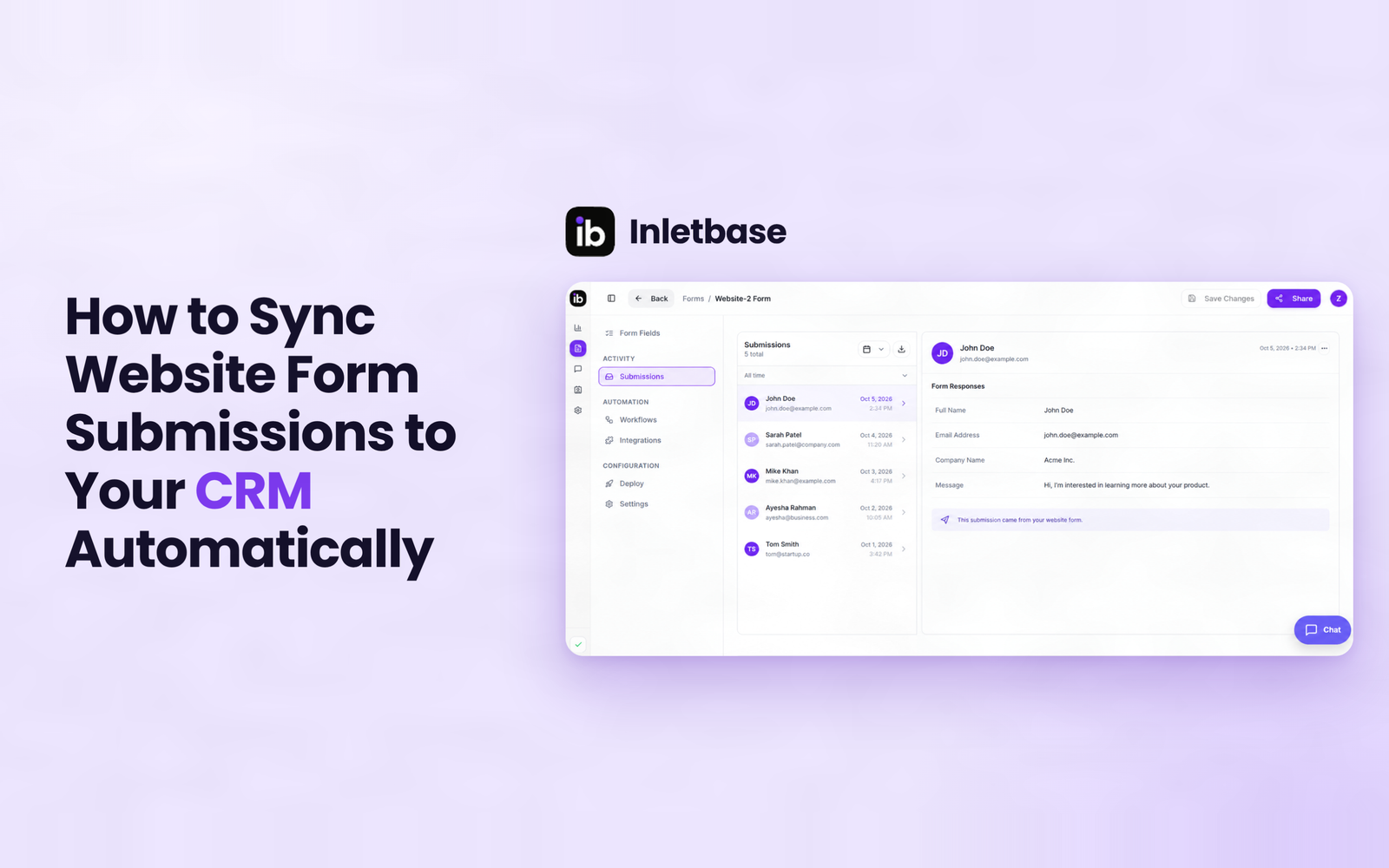
How to Sync Website Form Submissions to Your CRM Automatically
To sync website form submissions to your CRM automatically, send each submission to the CRM the moment it is submitted, using a native integration, a webhook, a connector tool or a CRM-hosted form. Map name, email, message, source and UTM fields, assign an owner on creation, match on email to avoid duplicates, and test every […]
ZaidOct 7, 2026
What Is a Form Backend? And How It Works
A form backend is a hosted service that receives the data from your website’s form, stores it, checks it for spam, and sends it on to places like your email, your CRM, or Slack. It does the work a server would normally do, so your form works without you building or running one yourself. At […]
ZaidOct 2, 2026
AI Chatbot for Website: What It Is and How It Works
An AI chatbot for a website is a chat box placed on a site that reads a business’s own pages, prices, and documents, then answers visitor questions in real, natural language, at any hour, without a person needing to be online. In This Article What Is an AI Chatbot for a Website? An AI chatbot […]
ZaidSep 26, 2026Latest articles
10 Best AI Chatbots for Websites in 2026
A chatbot on your website is not just a widget in the corner. It is the difference between a lead that gets captured and a visitor who leaves without a word. Someone lands on your site at 11 PM. They have one small question. There is no one at the desk to answer it. Do […]
ZaidSep 20, 2026
9 Best AI Tools for Form Submission in 2026
A form submission is not the end of the customer journey. It is where the real work begins.When someone fills out a form on your website, what happens next? Does the lead sit in an inbox? Does someone manually copy the details into a CRM? Does a sales team member decide who to contact first? […]
 Lana LucinSep 14, 2026